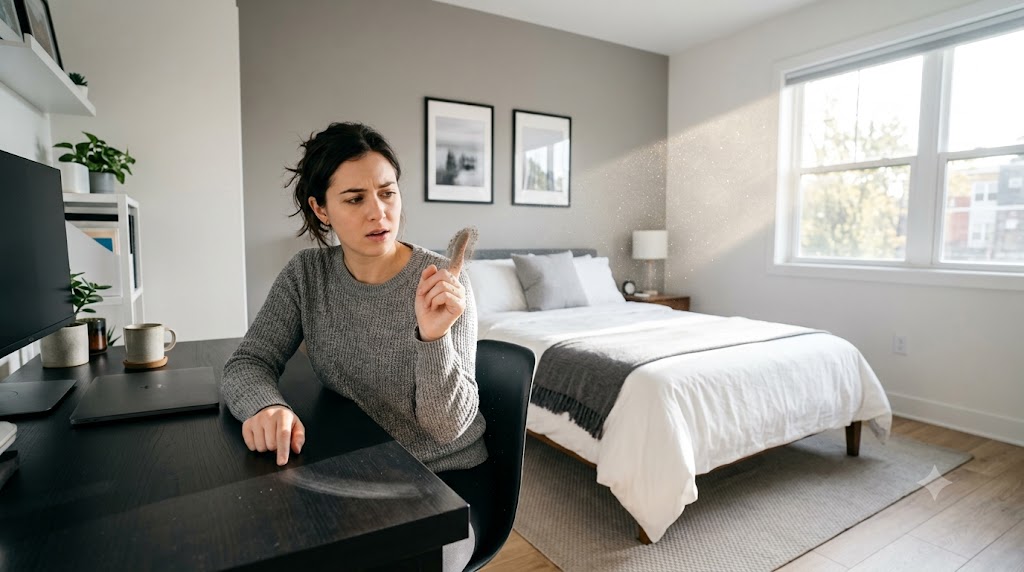
Your room gets dusty so fast that it can feel like yesterday’s cleaning did absolutely nothing.
You wipe the desk. Vacuum the floor. Clean the shelves.
Everything looks spotless.
Then the next morning, sunlight hits your room—and somehow the dust is already back.
So where did it come from?
The strange part is that some of that dust was probably already in your room while you were cleaning it.
And once you understand where it actually comes from, you’ll understand why it seems almost impossible to get rid of.
The Short Answer
Your room gets dusty so fast because cleaning removes dust that has already settled—it doesn’t stop new particles from entering or being created.
Every day, tiny particles can come from your bedding, clothes, carpets, hair, outdoor air and other materials around your home.
Even walking around, making your bed or opening a window can move particles through the air.
Eventually, they land right back on the surfaces you just cleaned.
Here’s the Weird Part: Cleaning Can Move Dust Around
This is one of the reasons dust can appear to return incredibly quickly.
Imagine wiping a shelf with a dry cloth.
You collect some dust.
But other tiny particles may be disturbed and sent back into the air.
The same thing can happen when you sweep the floor, shake a blanket or make your bed.
Those particles don’t necessarily disappear.
Some remain airborne for a while before eventually settling somewhere else.
Sometimes that’s the desk you cleaned an hour earlier.
So in a strange way, cleaning can temporarily make some dust harder to see before it settles again.
Your Bed May Be Producing More Particles Than You Realize
Look at how much fabric is inside a typical bedroom.
Sheets.
Blankets.
Pillows.
Clothes.
Curtains.
Carpet or rugs.
All of these materials can contribute tiny fibers and particles over time.
Your bed is especially important because you spend hours there every night and constantly move the bedding around.
Making the bed or changing the sheets can disturb particles that later settle throughout the room.
If you’ve ever wondered why your bedroom smells weird after sleeping all night, there’s another interesting reason your bedroom can feel different in the morning.
If your room gets dusty so fast, the location of the dust can reveal where it is coming from.
And No, Household Dust Isn’t Just Dead Skin
You’ve probably heard the claim that household dust is basically dead skin.
The reality is more complicated.
Household dust can contain a mixture of particles from both inside and outside your home.
Depending on the room, that may include fabric fibers, soil particles, hair, biological material and other microscopic debris.
And the exact mixture isn’t identical in every house.
That’s why eliminating one source doesn’t suddenly make a room dust-free.
Some of the Dust Is Coming From Outside
Even if your room stays extremely clean, your house isn’t sealed from the outside world.
Particles can enter when doors or windows open.
They can also be carried indoors on shoes, clothes and other objects.
Outdoor conditions can make a difference too.
Construction, traffic, pollen and dry conditions can all affect the particles around a home.
That creates an interesting situation:
Opening your window can improve ventilation, but depending on outdoor conditions, it may also allow additional particles inside.
Your Air System Can Move Particles Around Too
Heating and cooling systems circulate air through a home.
That movement can also affect where airborne particles travel and eventually settle.
Many systems use filters designed to capture certain particles as air moves through them.
That’s why filter condition and proper installation matter.
But don’t automatically buy the densest filter available.
Different HVAC systems have different airflow requirements, so filters should be selected and replaced according to the equipment manufacturer’s recommendations.
Sunlight Is Exposing Something You Couldn’t See Before
Here’s another reason your room can suddenly look incredibly dusty.
The amount of dust may not have suddenly changed.
The lighting did.
When a strong beam of sunlight enters a dark room, tiny airborne particles scatter the light.
Suddenly you can see particles that were almost invisible a few minutes earlier.
The same thing happens on dark furniture.
A television screen or black desk can look perfectly clean in one type of lighting and covered in dust under direct sunlight.
Sometimes your room didn’t suddenly become dirty.
You simply caught the dust in the right light.
Why Does One Room Get Dustier Than Another?
This is where things get useful.
If one room in your home constantly becomes dusty faster than the others, look for what’s different about that room.
Does it have more fabric?
Carpet?
An frequently opened window?
An air vent nearby?
More people walking through it?
A pet spending time there?
Instead of treating all household dust as one problem, look at where it accumulates fastest.
The pattern can give you clues about where the particles are coming from.
How to Stop Dust From Coming Back So Fast
You’ll never completely eliminate household dust.
But you can slow down how quickly it becomes noticeable.
Wash bedding regularly according to its care instructions.
Vacuum appropriate floors and rugs rather than relying only on sweeping.
For suitable hard surfaces, use a damp or dust-capturing cloth rather than simply pushing dry particles around.
Avoid letting unnecessary piles of clothing and fabric build up.
Check HVAC filters according to the manufacturer’s instructions.
And most importantly, pay attention to where the dust appears first.
If one particular shelf becomes dusty much faster than everything else, there may be a reason.
So Where Is All That Dust Actually Coming From?
There’s no secret dust factory hiding somewhere in your bedroom.
The answer is actually more interesting.
Your home never stops producing and collecting particles.
You move.
Your bedding moves.
Your clothes release fibers.
Air circulates.
Doors and windows open.
Particles enter, become airborne, settle, get disturbed and settle again.
That’s why your room gets dusty so fast even when you cleaned it yesterday.
Cleaning isn’t failing.
The dust never stopped moving.
When your room gets dusty so fast after cleaning, reducing the source can be more effective than simply cleaning more often.